Postpartum Mood and Anxiety: A Plan for the First Year
What is common and what is more, a weekly check-in, a support plan and the exact numbers to call.
By Whole Life HQ4 parts · about 4,400 words · printable · read online
Open your copy
You own this. Everything opens straight from here.
OpenWho it's for
New parents who feel low, anxious or not themselves after a baby, and the people close to them, who want a practical plan and the right numbers to call.
What you receive
- 4-part guide to mood and anxiety after a baby
- What is common and what is more, in plain words
- A weekly check-in, a support plan and scripts for asking for help
- The exact numbers to call, a month-by-month map and a clinician question sheet
4 printable pages, in reading order
- Part 1: What is common, and what is more
- Part 2: A weekly check-in routine
- Part 3: Building your support plan
- Part 4: Crisis help and the year ahead
See inside
The first 4 pages, as they print.
Look inside
The first page, word for word. 4 printable pages in total.
Part 1: What is common, and what is more
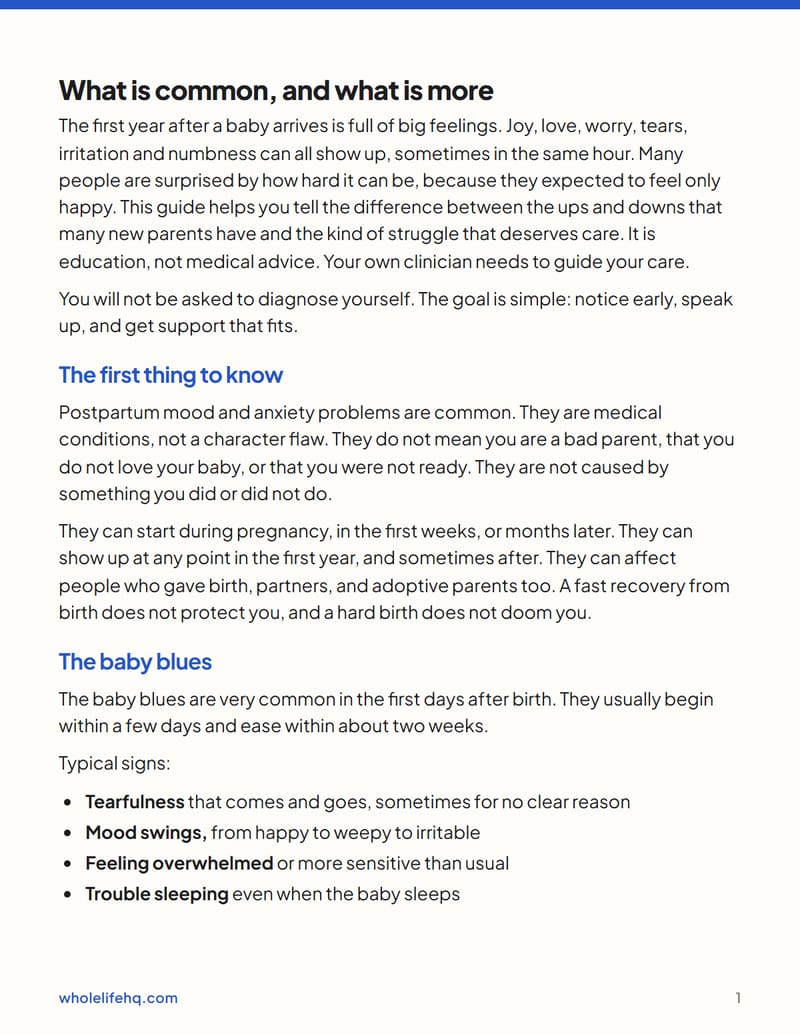
The first year after a baby arrives is full of big feelings. Joy, love, worry, tears, irritation and numbness can all show up, sometimes in the same hour. Many people are surprised by how hard it can be, because they expected to feel only happy. This guide helps you tell the difference between the ups and downs that many new parents have and the kind of struggle that deserves care. It is education, not medical advice. Your own clinician needs to guide your care.
You will not be asked to diagnose yourself. The goal is simple: notice early, speak up, and get support that fits.
The first thing to know
Postpartum mood and anxiety problems are common. They are medical conditions, not a character flaw. They do not mean you are a bad parent, that you do not love your baby, or that you were not ready. They are not caused by something you did or did not do.
They can start during pregnancy, in the first weeks, or months later. They can show up at any point in the first year, and sometimes after. They can affect people who gave birth, partners, and adoptive parents too. A fast recovery from birth does not protect you, and a hard birth does not doom you.
The baby blues
The baby blues are very common in the first days after birth. They usually begin within a few days and ease within about two weeks.
Typical signs:
- Tearfulness that comes and goes, sometimes for no clear reason
- Mood swings, from happy to weepy to irritable
- Feeling overwhelmed or more sensitive than usual
- Trouble sleeping even when the baby sleeps
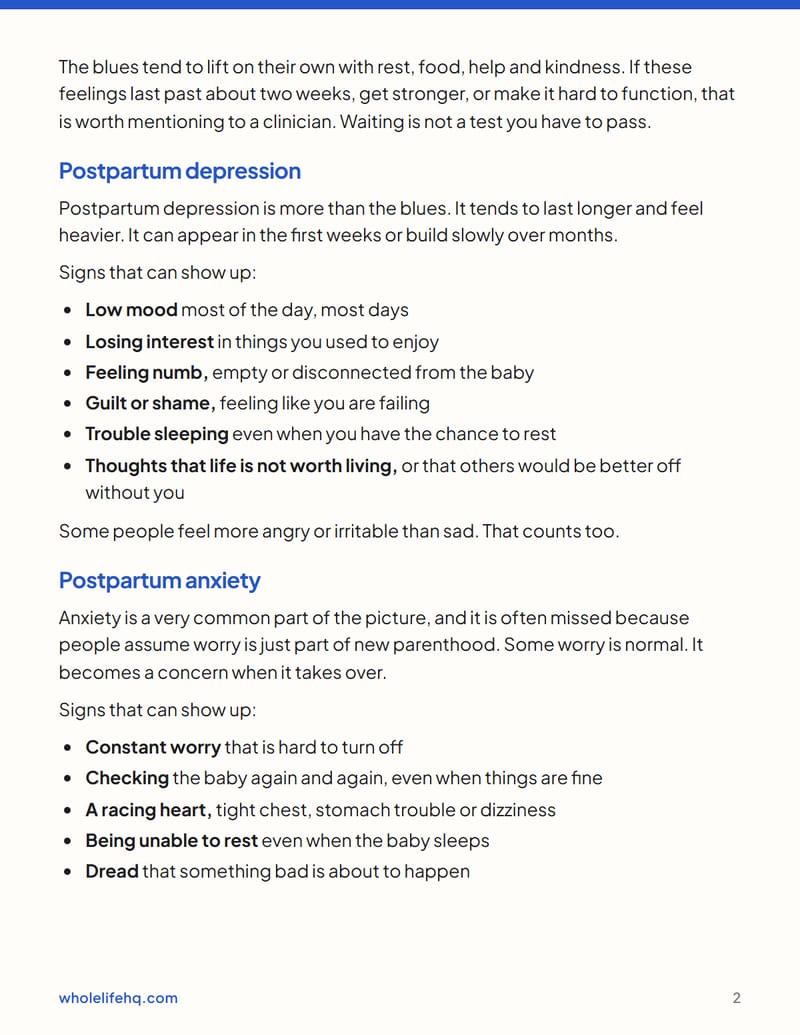
The blues tend to lift on their own with rest, food, help and kindness. If these feelings last past about two weeks, get stronger, or make it hard to function, that is worth mentioning to a clinician. Waiting is not a test you have to pass.
Postpartum depression
Postpartum depression is more than the blues. It tends to last longer and feel heavier. It can appear in the first weeks or build slowly over months.
Signs that can show up:
- Low mood most of the day, most days
- Losing interest in things you used to enjoy
- Feeling numb, empty or disconnected from the baby
- Guilt or shame, feeling like you are failing
- Trouble sleeping even when you have the chance to rest
- Thoughts that life is not worth living, or that others would be better off without you
Some people feel more angry or irritable than sad. That counts too.
Postpartum anxiety
Anxiety is a very common part of the picture, and it is often missed because people assume worry is just part of new parenthood. Some worry is normal. It becomes a concern when it takes over.
Signs that can show up:
- Constant worry that is hard to turn off
- Checking the baby again and again, even when things are fine
- A racing heart, tight chest, stomach trouble or dizziness
- Being unable to rest even when the baby sleeps
- Dread that something bad is about to happen
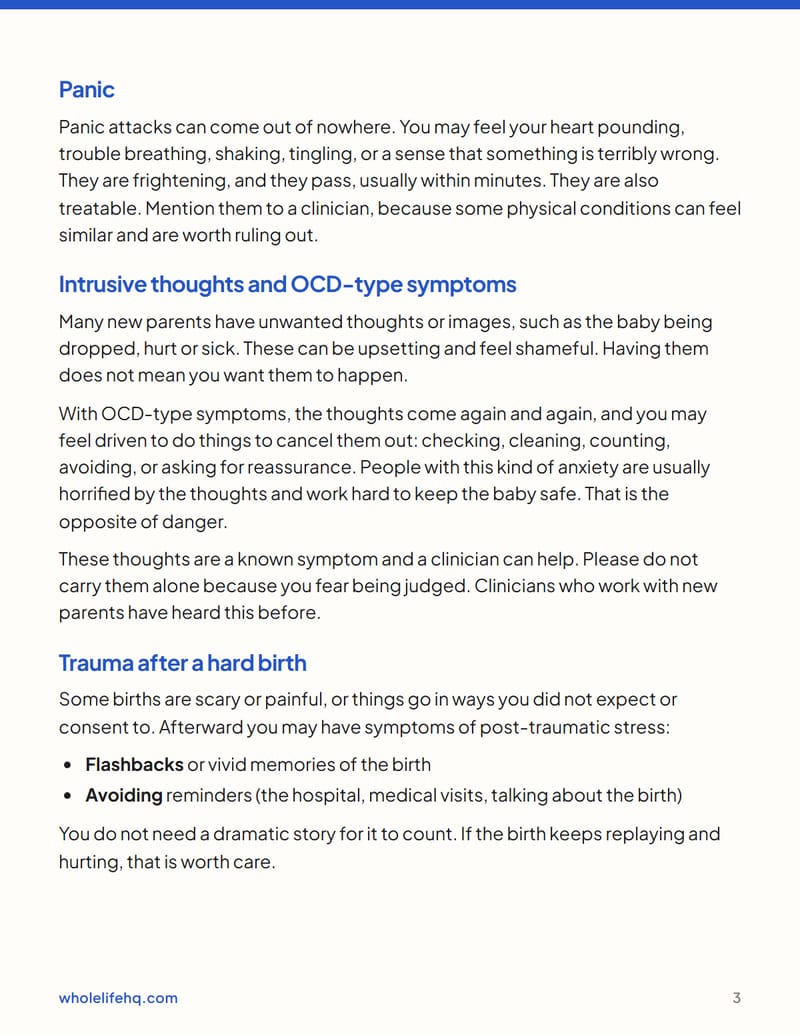
Panic
Panic attacks can come out of nowhere. You may feel your heart pounding, trouble breathing, shaking, tingling, or a sense that something is terribly wrong. They are frightening, and they pass, usually within minutes. They are also treatable. Mention them to a clinician, because some physical conditions can feel similar and are worth ruling out.
Intrusive thoughts and OCD-type symptoms
Many new parents have unwanted thoughts or images, such as the baby being dropped, hurt or sick. These can be upsetting and feel shameful. Having them does not mean you want them to happen.
With OCD-type symptoms, the thoughts come again and again, and you may feel driven to do things to cancel them out: checking, cleaning, counting, avoiding, or asking for reassurance. People with this kind of anxiety are usually horrified by the thoughts and work hard to keep the baby safe. That is the opposite of danger.
These thoughts are a known symptom and a clinician can help. Please do not carry them alone because you fear being judged. Clinicians who work with new parents have heard this before.
Trauma after a hard birth
Some births are scary or painful, or things go in ways you did not expect or consent to. Afterward you may have symptoms of post-traumatic stress:
- Flashbacks or vivid memories of the birth
- Avoiding reminders (the hospital, medical visits, talking about the birth)
You do not need a dramatic story for it to count. If the birth keeps replaying and hurting, that is worth care.
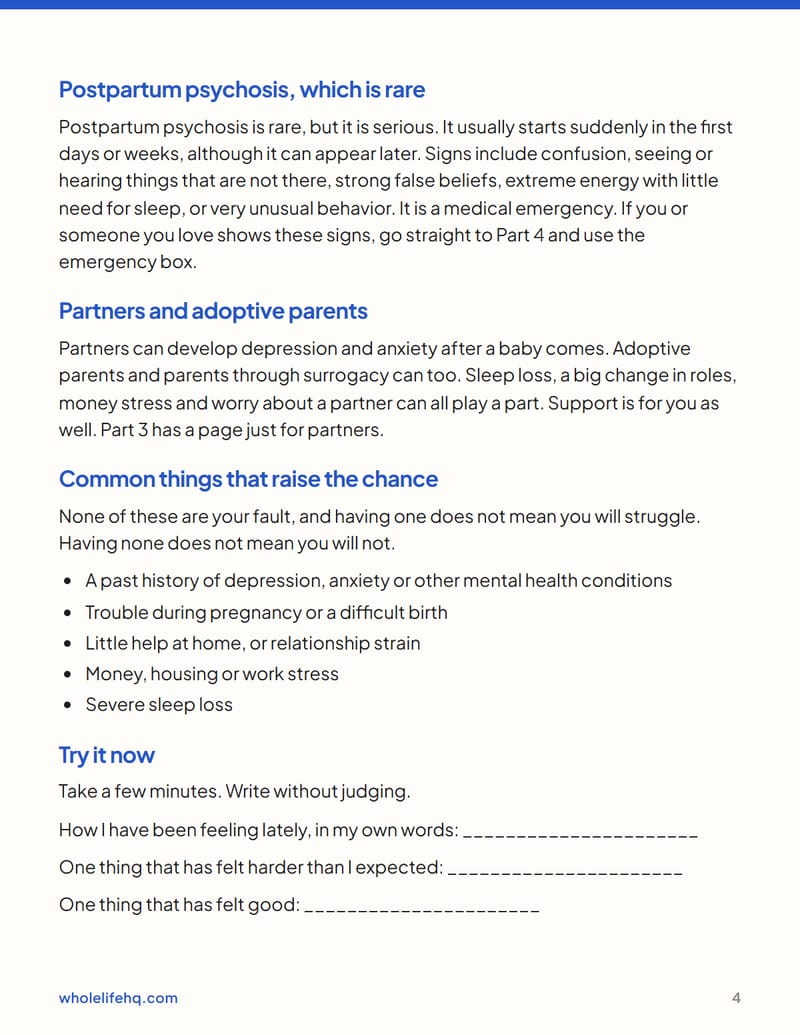
Postpartum psychosis, which is rare
Postpartum psychosis is rare, but it is serious. It usually starts suddenly in the first days or weeks, although it can appear later. Signs include confusion, seeing or hearing things that are not there, strong false beliefs, extreme energy with little need for sleep, or very unusual behavior. It is a medical emergency. If you or someone you love shows these signs, go straight to Part 4 and use the emergency box.
Partners and adoptive parents
Partners can develop depression and anxiety after a baby comes. Adoptive parents and parents through surrogacy can too. Sleep loss, a big change in roles, money stress and worry about a partner can all play a part. Support is for you as well. Part 3 has a page just for partners.
Common things that raise the chance
None of these are your fault, and having one does not mean you will struggle. Having none does not mean you will not.
- A past history of depression, anxiety or other mental health conditions
- Trouble during pregnancy or a difficult birth
- Little help at home, or relationship strain
- Money, housing or work stress
- Severe sleep loss
Try it now
Take a few minutes. Write without judging.
How I have been feeling lately, in my own words: ______________________
One thing that has felt harder than I expected: ______________________
One thing that has felt good: ______________________
Who is one person I could tell, even a little? ______________________
What is next
Part 2 gives you a weekly two-minute check-in, a worked example, and a list of who to tell. Part 3 builds a support plan. Part 4 covers crisis help and the year ahead. If you want a guide to the physical side of recovery, see The First 12 Weeks After Birth in this store.
What is in each part
- What is common, and what is more
- A weekly check-in routine
- Building your support plan
- Crisis help and the year ahead
What buyers say
Review this product
Downloads included
4 printable pages: see the list
- Part 1: What is common, and what is more
- Part 2: A weekly check-in routine
- Part 3: Building your support plan
- Part 4: Crisis help and the year ahead
They open in your library, and you can print them, once they are yours.
Who wrote it
Written by the Whole Life HQ team.
Not yet reviewed by an outside expert.
We plan to ask a women's health clinician to review it. Until then it is general information, not professional advice.
General information, not medical advice. Talk to your doctor before changing your exercise, eating or sleep, or if something worries you. If you are in crisis, call or text 988 (Suicide and Crisis Lifeline). In an emergency call 911.
How you get it
- In your libraryAfter you pay, it is in your library straight away.
- Any devicePhone, tablet or computer. Print it if you like paper.
- Yours to keepIt stays in your account, and you can come back any time.
