Breast Health: Self-Checks, Screening and What to Report
What is normal for you, a monthly self-check routine and log, which changes to report and how soon, screening in general terms and what to expect at the scan.
In Under $15
By Whole Life HQ4 parts · about 4,900 words · printable · read online
Open your copy
You own this. Everything opens straight from here.
OpenWho it's for
Women who want to know what is normal for their breasts, when to report a change and what screening involves, or who have been called back after a scan.
What you receive
- 4-part guide to breast health
- What is normal for you, a monthly self-check routine and a printable log
- Changes to report and how soon, screening in general terms and dense breasts explained
- What to expect at a mammogram or ultrasound, waiting for results and a question sheet
4 printable pages, in reading order
- Part 1: Knowing what is normal for you
- Part 2: The self-check routine and what to report
- Part 3: Screening, risk and what happens at the scan
- Part 4: Benign findings, waiting for results and your appointment
See inside
The first 4 pages, as they print.
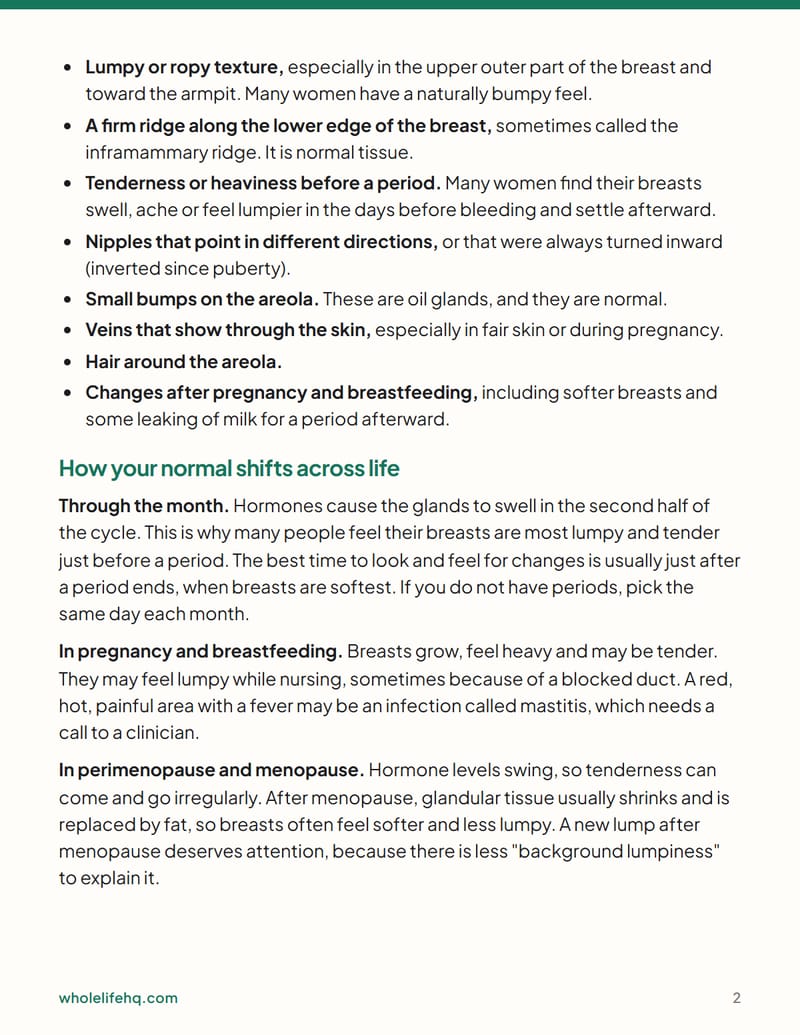
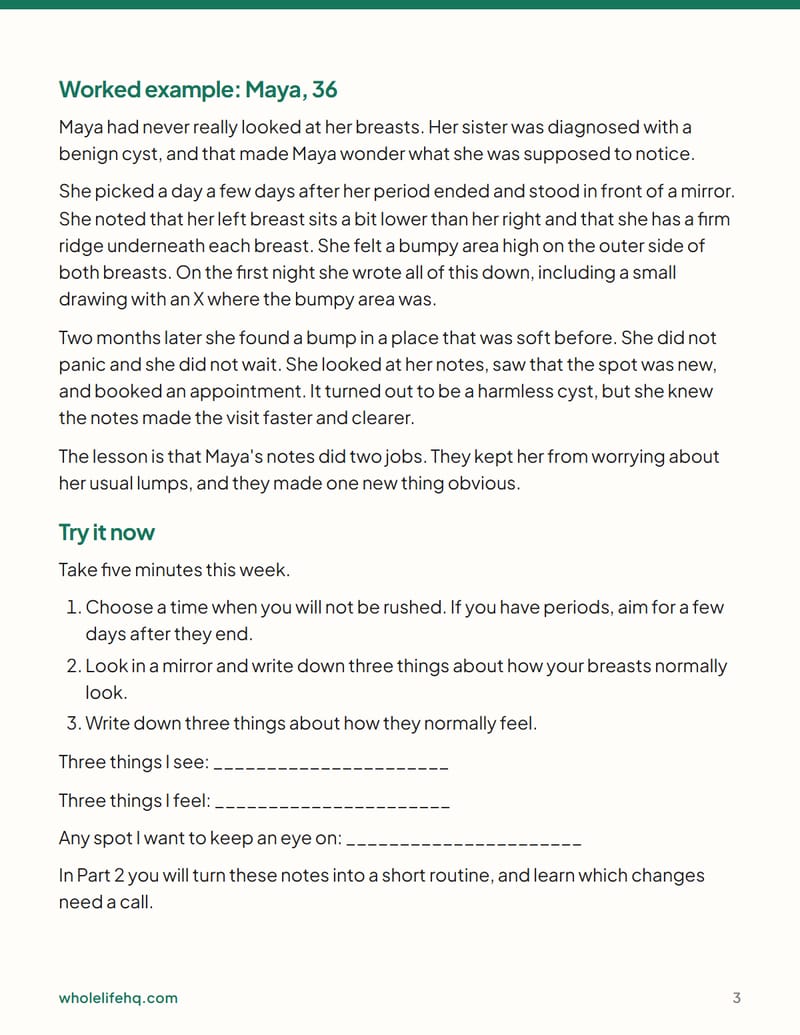
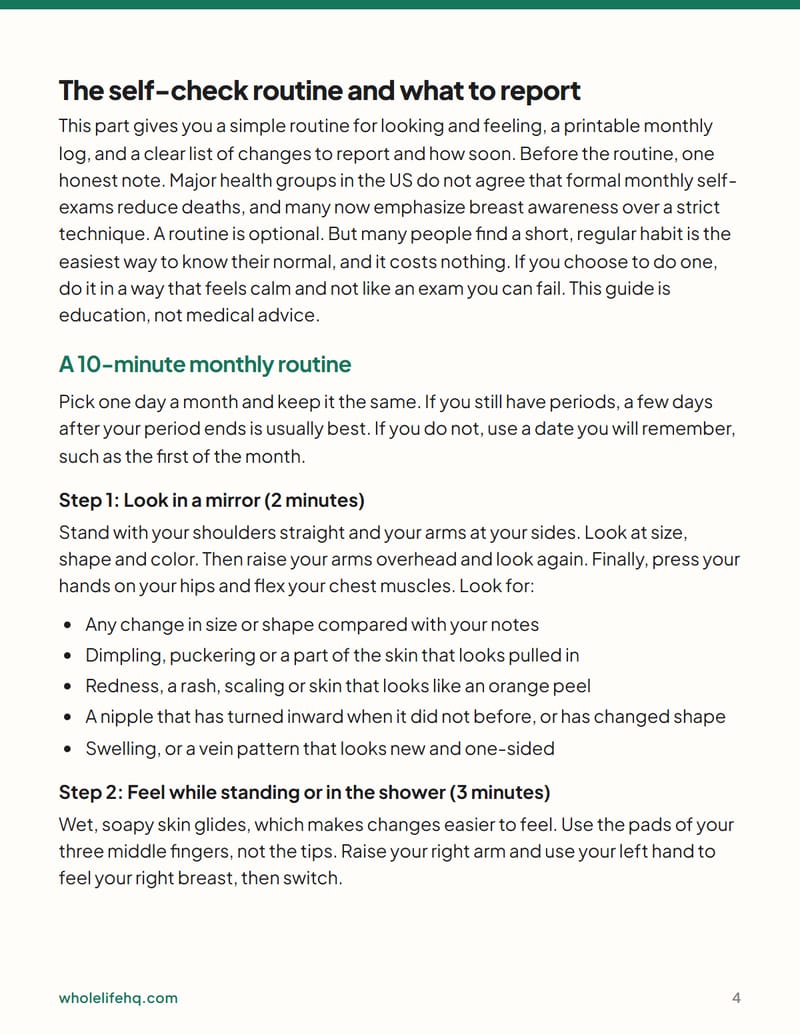
Look inside
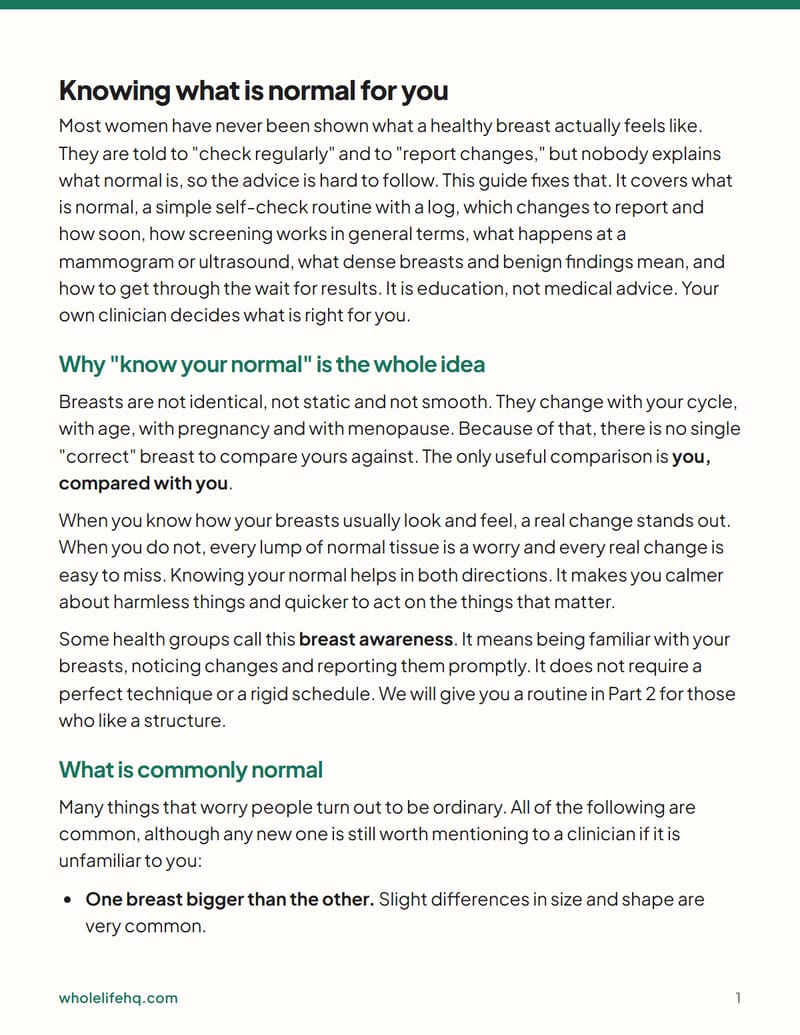
The first page, word for word. 4 printable pages in total.
Part 1: Knowing what is normal for you
Most women have never been shown what a healthy breast actually feels like. They are told to "check regularly" and to "report changes," but nobody explains what normal is, so the advice is hard to follow. This guide fixes that. It covers what is normal, a simple self-check routine with a log, which changes to report and how soon, how screening works in general terms, what happens at a mammogram or ultrasound, what dense breasts and benign findings mean, and how to get through the wait for results. It is education, not medical advice. Your own clinician decides what is right for you.
Why "know your normal" is the whole idea
Breasts are not identical, not static and not smooth. They change with your cycle, with age, with pregnancy and with menopause. Because of that, there is no single "correct" breast to compare yours against. The only useful comparison is you, compared with you.
When you know how your breasts usually look and feel, a real change stands out. When you do not, every lump of normal tissue is a worry and every real change is easy to miss. Knowing your normal helps in both directions. It makes you calmer about harmless things and quicker to act on the things that matter.
What is in each part
- Knowing what is normal for you
- The self-check routine and what to report
- Screening, risk and what happens at the scan
- Benign findings, waiting for results and your appointment
What buyers say
Review this product
Downloads included
4 printable pages: see the list
- Part 1: Knowing what is normal for you
- Part 2: The self-check routine and what to report
- Part 3: Screening, risk and what happens at the scan
- Part 4: Benign findings, waiting for results and your appointment
They open in your library, and you can print them, once they are yours.
Who wrote it
Written by the Whole Life HQ team.
Not yet reviewed by an outside expert.
We plan to ask a women's health clinician to review it. Until then it is general information, not professional advice.
General information, not medical advice. Talk to your doctor before changing your exercise, eating or sleep, or if something worries you. If you are in crisis, call or text 988 (Suicide and Crisis Lifeline). In an emergency call 911.
How you get it
- In your libraryAfter you pay, it is in your library straight away.
- Any devicePhone, tablet or computer. Print it if you like paper.
- Yours to keepIt stays in your account, and you can come back any time.
